Why Your Well Pump Keeps Turning On and Off
Short cycling wears out a pump motor fast, and the cause is often the pressure tank sitting next to it.
October 7, 2026 · 4 min read
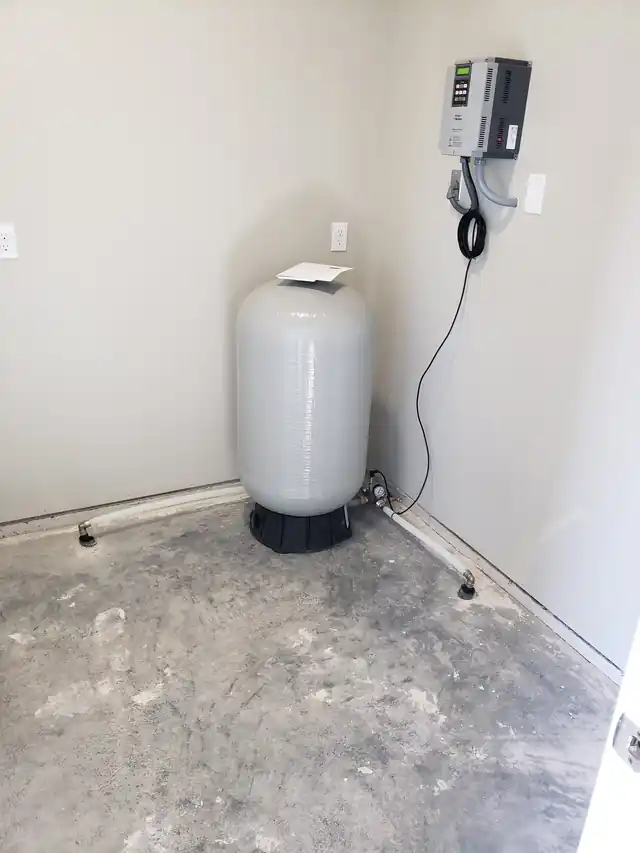
You run a little water to rinse a dish and hear the pump kick on. Ten seconds later it shuts off. Then it starts again. If your well pump seems to be turning on and off far more than it used to, it is short cycling, and it is worth sorting out sooner rather than later. Starting is the hardest thing a pump motor does, so a pump that starts dozens of times an hour wears out much faster.
The good news is that short cycling often points at one part: the pressure tank. Here is what that tank does, what goes wrong with it, and how to tell when the problem is somewhere else.
What the pressure tank actually does
Most homes on a private well have a pressure tank in the utility room, the garage or the pump house. It looks like a big painted cylinder standing on the floor. Inside is a cushion of air. Water from your well gets pumped into the tank and squeezes that air, and when you open a faucet the squeezed air pushes the stored water out to the house without the pump needing to start right away.
Akland's own answer to this question is short and worth repeating: a pressure tank holds a small amount of water to help keep your pump from turning on every time you use it. That is the whole job. It is a buffer, not a booster.
That also clears up a common mix-up. A pressure tank does not cause high pressure or low pressure. The pressure you feel at the tap comes from the pump and the pressure switch settings. A typical household switch might start the pump when pressure falls to around 40 psi and shut it off near 60, though yours may be set differently. With a healthy tank, you can fill a glass or rinse a plate and the pump stays quiet through most of it.
What short cycling looks like
- The pump starts and stops every few seconds while you are using only a little water.
- You hear the pressure switch click over and over.
- Water at the faucet surges or pulses instead of staying steady.
- The pump runs for a few seconds, shuts off, and kicks in again as soon as you take another small drink of water from the system.
The usual cause: a tank that has lost its air
According to Akland's FAQ, if your pump is cycling (turning on and off often or rapidly), then your tank may need to be recharged with air, or it may be in need of replacement. Those are the two usual outcomes, and they both come back to the air cushion.
Over time a tank can lose its air. When there is not enough cushion left, the tank fills with water, there is nowhere for the pressure to ease, and the pump hits its shutoff pressure almost immediately. The first glass of water drops it right back down and the pump starts again. Recharging the air can bring a tank back to life. If the tank is old, rusted, or has an inside membrane that has failed, a recharge will not hold and the tank needs to be replaced.
Signs of a tank that has given out include rust streaks, water weeping from the bottom seam, or water (not air) spitting from the little tire-style valve on top, which usually means the membrane inside has failed. Checking the air charge properly is done with the power off and the tank drained, which is one reason most people hand it to a shop.
Levi Brewer wrote in a Google review: “These guys did a great job installing a new pressure tank for me. They were fast and made it right after some slight miscommunication on the invoicing.”
When it is not the tank
Not every short cycling problem lives in the tank. A few other causes show up often enough to rule out. A pressure switch can be worn or set badly. A leak in the house plumbing, even a toilet that runs a little, can make the pump start again and again on tiny pressure drops. And a pump that is struggling to keep up with the well can run and quit in an uneven pattern too.
Here is a simple check you can do yourself. Shut off every tap and appliance that uses water, then watch the pressure gauge near the tank for a few minutes. If the needle slowly creeps down and the pump starts up with nobody using water, you have a leak somewhere, and a new tank will not cure it.
Do not live with it
Every extra start is wear on the motor and the pressure switch, and a failed tank will not fix itself. Akland recommends a yearly service check on a domestic house pump to make sure everything is running smoothly.
When you call, describe what you hear: how many seconds the pump runs, how often it starts, and whether the gauge is jumping or sitting still. That description alone often tells the shop if it is a recharge, a new tank or something else. Call (509) 452-7867, or stop by 3701 Fruitvale Blvd, Monday through Friday, 7:30 to 5. If your pump quits after the shop has closed for the day or weekend, call the same number and you can get the number for the after hours service technician.
Akland Pump & Irrigation, (509) 452-7867
Call (509) 452-7867More articles
Replacing a Well Pump: What to Have Ready Before You Call
Three numbers about your well let a pump shop put together a real estimate over the phone.
When to Blow Out Your Sprinkler System in Yakima
Wait too long and a freeze can split valves and pipes you cannot see until next spring.